

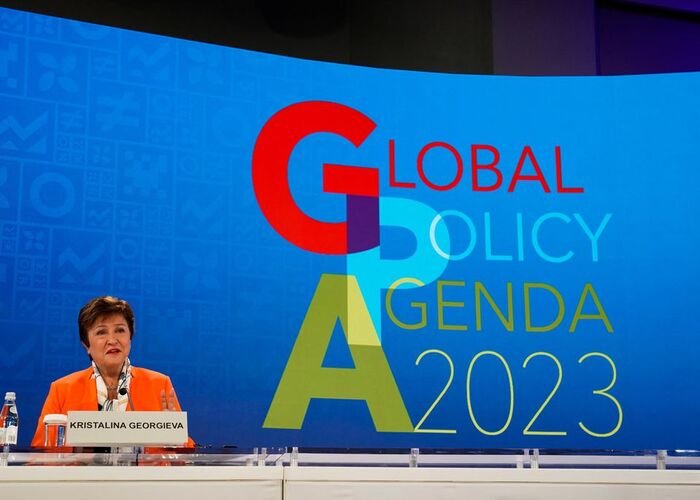
On Thursday, International Monetary Fund Managing Director Kristalina Georgieva urged policymakers against a new Cold War as they increase attempts to protect industrial supply chains amid geopolitical tensions between major nations.
Can we increase supply security without starting a second Cold War? In Washington, Georgieva held a press conference. “It’s possible.”
Georgieva, who grew up in Bulgaria during the Cold War, said she didn’t want to see it happen again.
On Wednesday, G7 finance chiefs vowed to empower low- and middle-income nations to diversify supply chains to make them more robust and sustainable.
Their communique did not mention China. However, the supply chain language fit with “friend-shoring” efforts by U.S. Treasury Secretary Janet Yellen and other Western leaders to trade more with allies and become less reliant on the Asian manufacturing powerhouse for battery minerals, semiconductors, and other strategic goods.
The IMF has warned that escalating geopolitical tensions and economic fragmentation might heighten financial stability risks and cut global economic output by 0.2% to 7%.
It’s one of the main reasons the IMF anticipates sluggish global growth for years.
Georgieva suggested authorities embrace the expense of developing new, more fragmented supply chains.
“Security of supplies and the reliable functioning of global supply chains is taking a new, higher priority seat in economic discussions,” she added, citing the COVID-19 epidemic and Ukraine war. However, she cautioned against disrupting global trade.
If we’re not sensible, everyone suffers. Georgieva claimed each country’s middle class would pay. “So a bit more cool-headedness would take us a long way.”
The IMF has warned of growing costs and economic friction due to the global economy fragmenting into geopolitical blocs, with U.S.-led democracies on one side and China’s authoritarian regimes on the other. In addition, competing technological systems can reduce commerce. Rising tensions might also cause capital outflows, including direct investment, from countries with high risks for developing and emerging market economies, according to a recent IMF working paper.
However, French Finance Minister Bruno Le Maire said France, the E.U., and the U.S. must secure supply chains for essential items like electric car batteries and minimize their dependency on China. He distinguished “de-risking” supply chains from “de-coupling” from China.
He stated, “I think that we need to engage China if we want to craft responses to the greatest challenges of the 21st century,” including climate change and debt relief.
A top U.S. Treasury official claimed China’s economic protectionist policies contributed to fragmentation.
“They are moving in a direction that is closing off the world and bifurcating themselves from things like the market-oriented policies that allowed them to rise so rapidly,” the official said of China.
Georgieva said the IMF expects China to recoup strongly in 2023 after its COVID-19 openness, accounting for nearly one-third of global growth.

